
Coupon Statistics Everyone Should Know About

Most of us will agree there’s something very gratifying about using coupons to save money, but how much do we actually know about them? Even those who use coupons daily probably don’t know that the history of coupons goes back more than a century.
It all started in 1887 when Asa Candler, an Atlanta businessman and the owner of Coca-Cola, decided to try something new and created the very first coupon. These hand-written coupons offered customers a free glass of Coca-Cola, and although many thought Candler was out of his mind, this marketing strategy made Coke the most popular nonalcoholic drink on the market.
Between 1894 and 1913, about 8,500,000 free glasses of Coke were given out to Americans through this first coupon program. It was the beginning of a tremendously successful marketing strategy.
Today, we’re so used to coupons affecting our shopping decisions we don’t even notice it. To understand how coupons work and how they worked in the past, we bring you some of the most interesting numbers we’ve managed to dig out.
Key Coupon Statistics for 2026 - Editor’s Choice
- More than 93% of digital coupon users in the US are expected to redeem coupons on their smartphones this year.
- The global mobile coupons market is valued at approximately $1.42 trillion as of early 2026.
- 62% of U.S. shoppers look for promo codes and coupons when shopping online in 2026.
- A third of US consumers with incomes over $100,000 use discount hunter sites.
- Smartphone coupon user penetration in the US is expected to reach 93.8% by the end of 2026.
92% of US shoppers use coupons at least once a year.
(Statista)
Based on a survey of 1,000 respondents, more than nine out of ten stated that they used at least one coupon that year, and this number has been highly consistent in the past decade.
The global mobile coupons market is expected to reach $3.94 trillion by 2035.
(ResearchAndMarkets)
It is projected that the market will grow at a 10.8% CAGR starting in 2026, and that it will pass the $1.7 trillion mark this year.
Coupons influence 86% of consumers to try new products.
(Business Wire)
89% of respondents said using coupons saved them a lot of money, and 85% of them confirmed they were willing to go to multiple shops looking for the best price.
92% of US shoppers look for special offers and coupons before buying online.
(Statista)
This survey showed that only 8% of shoppers rarely or never look for coupons when shopping online. More recent data suggests that while "looking" remains high, active usage of promo codes specifically sits at roughly 62% for all online transactions.
Online buyers who use coupons spend 25% more than those who don’t use them.
(Blippr)
This report also revealed that 81% of respondents used their mobile devices to make at least one purchase, while 53% of online shoppers use physical coupons in addition to digital ones.
77% of shoppers prefer to get their coupons via email.
(eMarketer)
The latest data shows that only 19% of shoppers prefer getting coupons via direct mail. As of 2026, 80% of consumers state they prefer brands that personalize coupon communications based on their loyalty status.
More than 850 million coupons are redeemed each year.
(Coupons In The News)
Digital coupons now account for one-third of all redemptions, with average redemption rates for digital offers exceeding 7%.
38% of shoppers decide to buy a product sooner than planned if they have a coupon.
(CapitalOne Shopping)
The same data also indicates that 67% of Americans make unplanned purchases due to coupons, proving how powerful they can be in driving consumer interest.
30% of shoppers redeem their digital coupons within 24 hours.
(Inmar)
Another interesting tidbid from Inmar’s study informs us that 82% of shoppers redeem a digital coupon in less than a week.
One of the things that make coupon shoppers appreciate the whole process even more are personalized offers. 53% percent of respondents confirmed they wanted relevant offers based on their previous purchases, while 51% said they wished to have exclusive offers based on their loyalty to a specific brand.
42% of shoppers look use Facebook to discover coupon deals.
(Statista)
The latest data shows that Meta's platforms are dominating the space when it comes to coupons, discounts and deals, with Instagram being used by 30% of shoppers and Facebook groups by 18%.
Personalized coupons have a 30% higher redemption rate than generic offers.
(Global Growth Insights)
The era of mass couponing is ending. By 2026, AI-driven personalization that targets users based on past purchase history has become the standard for high-performing loyalty programs.
67% of shoppers made a purchase they initially didn’t intend to make because of a coupon.
(RetailMeNot)
Coupons can trigger purchases we initially didn’t intend to make. Four out of five shoppers would feel comfortable enough to make a first-time purchase with a new brand if it offered them a coupon. And based on the data, nearly a half would avoid brands that don’t offer any.
71% of shoppers look for coupons on store websites.
(Valassis)
There are a lot of places to find coupons these days. You don’t necessarily have to buy newspapers and browse through coupon books to find good deals. Nowadays, customers usually turn to various websites and mobile savings apps when looking for coupons and special promotions.
Household are the most searched online coupon category in the US.
(Statista)
47% to 48% of respondents confirmed they were looking to find coupons for these types of products.
Unsurprisingly, the next category on the list was restaurant delivery options, with 41% of shoppers interested, and grocery delivery options with 40% of them.
Households earning over $150,000 per year are 27% more likely to regularly use digital discount coupons.
(Capital One Shopping)
Contrary to popular belief, coupons are not reserved for those with low income. In fact, affluent consumers in the US are among the most active coupon hunters in 2026.
In 2022, more than 145.3 million Americans used couponing apps.
(RSA America)
It looks like in the past couple of years digital coupons have taken over the old-fashioned ones. And although paper coupons still have a higher rate of redemption, more and more Americans embrace digital coupons and turn to couponing apps instead of coupon books.
There are plenty of possibilities when it comes to finding coupons online, and some of the top coupon apps available are Honey, Rakuten, and Ibotta.
34% of shoppers spent 5 to 10 minutes sarching for digital coupons in 2024.
(Statista)
Additionally, 26% spent less than 5 minutes looking for digital coupons last year.
31% of consumers with incomes over $100,000 used discount hunter sites in 2024.
(Civic Science)
Contrary to popular belief, coupons are not reserved for those with low income. In fact, the richest consumers in the US hunt for coupon discounts the most.
33% of shoppers in the US used coupons while grocery shopping in 2024.
(Civic Science)
The data has showed that this percentage has increased from 26% the year before.
The Demography of Couponing
89% of Millennials would try a new brand if they had a coupon for it.
(Statista)
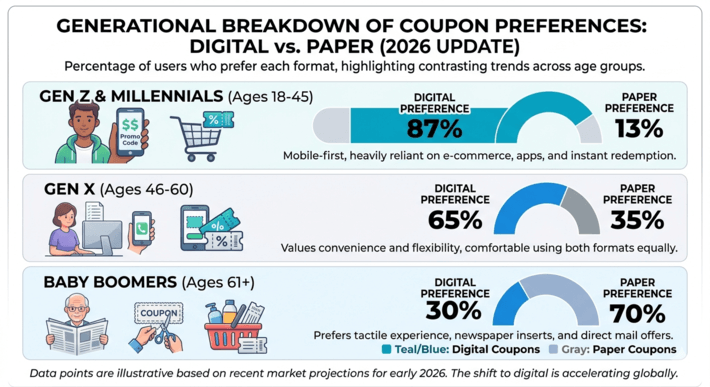
Baby Boomers are least open to new brands, with “only” 76% of them interested in trying them out. Gen Z is right above them with 78%, and 86% of Gen Xers are willing to give a new brand a chance if they get a coupon for it.
43% of Millennials share deals through social media.
(Valassis)
Shoppers are often skeptical about new brands and reluctant to try them. Millennials rely heavily on social media for recommendations of new brands and finding promotions and special deals. 90% of Millennials share deals, and 43% of them do it through their social media accounts.
70% of Millennials search for coupon deals on their phones.
(CouponFollow)
The same survey found that search from computers dropped by a whopping 20%.
96% of Baby Boomers in the US use coupons.
(Coupon Science)
70% of Baby Boomers use old-fashioned paper coupons, 32% confirm they use online coupons as well, and only about 17% of respondents use mobile coupons.
48% of women in the US download digital coupons through their smartphones while in-store.
(Retail Dive)
On the other hand, “only” 35% of men do the same. When it comes to comparing prices, it seems like men are in the lead. 63% of them use smartphones to check and compare prices while in-store, compared to 46% of women doing the same thing.
73% of women use coupons to buy clothing and accessories.
(Statista)
In contrast, 61% of men do the same. 63% of female shoppers use coupons for cosmetics and personal care products, compared to 52% of male shoppers in the same category.
64% of men use coupons to buy food and utilize food delivery services.
(Statista)
Electronics are another category men like to spend their coupons on - 63% of them compared to just 41% of women. Another thing we learned from this survey is that 48% of men use coupons to shop for household appliances, followed by 35% of women.
80% of Gen Xers use coupons while planning their shopping lists.
(Valassis)
Some 75% of all shoppers use coupons when planning their shopping list.
Receiving a coupon helps 82% of Millennial parents come to a decision to make a purchase.
(Valassis)
Based on Valassis’s report, 60% of all surveyed shoppers confirmed receiving a coupon or a discount sped up their decision to purchase a particular product. 75% of all parents - participants of this survey - agreed to this, compared to 82% of Millennial parents.
In Conclusion
Nowadays, coupons can be found everywhere around us, in the newspapers, at the back of a receipt, as well as on numerous coupon sites and coupon apps available to us. There are various statistics that convincingly demonstrate how beneficial they can be both for businesses offering them and consumers.
Saving-centric customers who have a savings account and similar financial habits are most likely to be drawn by a coupon campaign, although the numbers we have gathered here indicate that generally speaking, all categories of consumers react well to coupons.
Sources

Albert Einstein is said to have identified compound interest as mankind’s greatest invention. That story’s probably apocryphal, but it conveys a deep truth about the power of fiscal policy to change the world along with our daily lives. Civilization became possible only when Sumerians of the Bronze Age invented money. Today, economic issues influence every aspect of daily life. My job at Fortunly is an opportunity to analyze government policies and banking practices, sharing the results of my research in articles that can help you make better, smarter decisions for yourself and your family.