

AI Is Not Just Replacing Workers. It Is Replacing Pay Raises.

Artificial intelligence has already become a key factor, as well as a convenient excuse that many companies across different sectors use when announcing massive layoffs in the recent months.
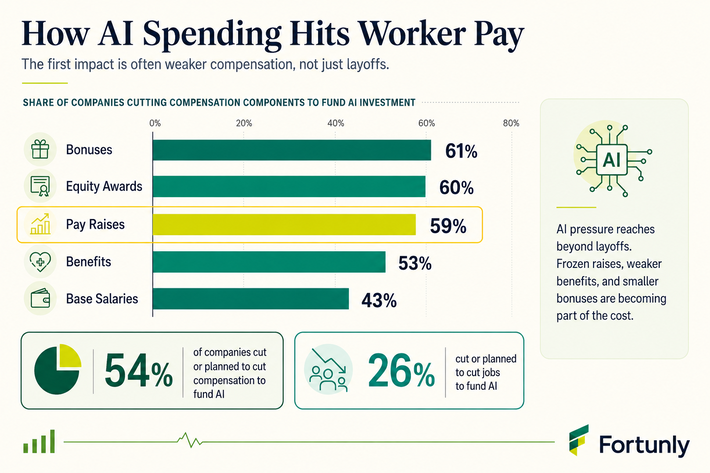
But what’s gone largely unnoticed is how employees are starting to suffer in different ways even when there are no job cuts in their companies, as freezes in raises, paused bonuses, weaker benefits packages and lower retirement contributions are now directly caused by increased AI spending.
To give you an example, Teradata, which is one of the largest cloud analytics and software companies in the world, recently told its roughly 5,100 employees that they would not get annual salary increases in most regions, as the company looks to reallocate those resources toward hiring new AI talent and increasing AI capabilities.
This new trend shows that layoffs are only a part of the problem, and that workers are not only at risk of job loss, but that they are becoming valued less and less, even when they get to keep their jobs.
AI Spending Hiding a Weaker Business Environment
The time frame in which the increase in AI spending is happening is also something that’s important to keep in mind.
A strong economy and a booming market in which money is cheap historically lead to higher investments and expansion, but the current business environment is all but that.
With rising inflation, higher financing costs, cautious consumers and weaker demand in many of the sectors, AI cannot simply be viewed as a growth tool.
It is instead often adopted in a cost-cutting environment, allowing companies to present austerity as innovation.
A good example of this would be the infamous Allbirds announcement, when this shoe company recently announced it is shifting into the AI business.
This was a struggling brand that had already agreed to sell its footwear assets before rebranding as NewBird AI with the goal of moving into AI computing infrastructure.
The announcement caused its shares to rise by more than 400%, before quickly collapsing back almost to the same price before that shift
That is exactly what makes the current environment so dangerous.
During this boom cycle, AI spending is more and more used as a band-aid and a market narrative rather than a sound business decision, with little to no benefits to employees that work there.
Even worse, it can be used as a justification for pay freezes and cost-cutting measures, with no real long-term benefit for either workers or the company’s financials.
The Productivity Trap
Productivity is easily one of the main selling points of artificial intelligence, as most of us have actually seen how this technology can positively impact the amount of work we can do in a day.
Nearly all desk-based jobs are now impacted by AI, and these tools allow us to work faster than ever before. In theory, this increase in productivity should make workers more valuable, but the reality is that many people simply see no benefits from it, and in a lot of cases, the increase in productivity is captured by companies, while employees are slowly but surely losing their bargaining power.
Business owners are now not only expecting more from their employees, but are also valuing them less, as AI is seen more as something that makes jobs easier, rather than making employees that utilize its capabilities more worthy.
This has become a huge new point of labor-market pressure, as many workers are expected to produce more with AI, while also using AI as justification for paying those employees less for their increased output.
All of that creates a vicious cycle in which workers see weakened compensation and growth all while being more productive than ever, but also feeling like their job is less rewarding as they lean more and more on these tools rather than using their own expertise, research skills and critical thinking.
Benefit Cuts As a Form of Pay Reduction
Salary freezes are only a part of a larger problem, as AI is now also directly impacting employee benefits.
TTEC, which is a customer service company with around 60,000 employees, recently paused its 401(k) contributions for workers through the end of 2026, citing the need to fund AI tools, training and automation rather than providing its employees with their retirement benefits this year.
This is another way that companies are now using AI as a bludgeoning force against their workforce, not freezing raises or laying off employees, but instead cutting their long-term benefits such as stock grants, retirement contributions or bonuses.
Even when such measures are presented as temporary or necessary, the financial impact on employees can be felt much longer and be more devastating for their future.
If you’re a younger employee and a company freezes your retirement contributions, you can lose decades of growth for each missed payment, while older employees are left with fewer years to make up the difference.
A Workforce That Stays Employed but Falls Behind
Layoffs in general are highly unpopular and extremely visible news events, not only leaving the remaining workers jaded and unmotivated, but also potentially scaring off new investors.
This new approach is much subtler, leaving workers employed, but forcing them to fall behind
You are expected to be grateful to keep your job, while also losing your raises, promotions and retirement contributions.
It is a deterioration of labor value that is harder to see in official data, but is also something that could easily become one of the defining features of this AI-based economy.
Even if the company plans to lay off a portion of its staff, the management can now employ this stage-by-stage strategy of reducing the benefits and freezing raises, both in preparation for what’s to come, or in order to force employees to quit in order to find a job that compensates them more fairly for their work, therefore offsetting the negative PR that would come from straight layoffs.
The Psychological Impact
Some companies today are severely underestimating the psychological impact and the negative morale effects that these decisions lead to.
If you’re asked to train an AI agent to replace you in the future, or to accept that you will not get a raise this year because the company needs that money to invest in AI, the message that employees get is that their hard work and loyalty is being underappreciated.
This can lead to resentment and distrust, with workers viewing AI as a direct threat to their employment. Your workplace culture can start to suffer, you can see an increase in turnover rate, and the most talented employees may be the first ones to start looking for better opportunities elsewhere.
That is the part of the equation that many employers seem to ignore.
AI adoption can be done in a positive way for both the business and its employees, but doing it in such a way that risks the workers’ long-term financial security and motivation is not the way to go.
If employees see technological advancement as a threat rather than a benefit, you can and will create a bad workplace environment, with a more defensive and disengaged workforce.
The Cost of Over-Reliance on Imperfect Technology
Lastly, we have to highlight how AI is nowhere near the level of quality and sophistication that many of the tech billionaires are selling it as.
While the current apps are certainly impressive and useful, they are still highly prone to mistakes, hallucinations, and other reasoning and contextual issues.
Because of this, using AI as an excuse to weaken the workforce instead of elevating it can lead to huge problems and negative financial ramifications, basically creating more problems than it is solving.
In industries where such mistakes are expensive, such as finance, insurance, healthcare, legal services, customer support or accounting, errors can create compliance issues, customer losses, legal exposure or security risks.
Leaning too hard on AI and neglecting your employees can therefore save money in the short term, but it can also easily lead you to lose crucial institutional knowledge and quality control, which is not something that is easily rebuilt after it's gone.
How to Move Forward
The truth is that AI and everything that comes with it is not an inherently negative thing. On the contrary, these tools are already impressive and can have a massive impact on employee productivity.
We just have to remember that such advancements should have a more positive impact on workers. If they instead lead to weakening compensation and security, we must understand that such business moves are not innovation, but rather a cost shifting measure.
This tech is and will continue to change our world in a radical way, but those companies that forget the value of experience and the intelligence of their workers may discover that the cost of pushing out human expertise could be far greater than they ever considered.

I have always thought of myself as a writer, but I began my career as a data operator with a large fintech firm. This position proved invaluable for learning how banks and other financial institutions operate. Daily correspondence with banking experts gave me insight into the systems and policies that power the economy. When I got the chance to translate my experience into words, I gladly joined the smart, enthusiastic Fortunly team.