
Liquidity in Trading Explained

Liquidity refers to the speed and ease with which an asset can be converted into cash without significantly changing its market price.
High liquidity allows buyers and sellers to execute trades instantly and at stable prices, while low liquidity usually leads to longer exits and price slippage.
What Is Liquidity?
At its core, liquidity is what defines a market’s efficiency. Whenever a market is described as being liquid, it means that transactions within it happen with almost no friction at all.
There are two types of liquidity that you’ll encounter on a daily basis as a trader, and those are market liquidity and accounting (funding) liquidity.
Market liquidity is that describes the state of the market itself. This is why huge markets like the S&P 500 are considered to be highly liquid, due to the fact that there are millions of people participating in them at any moment.
Accounting liquidity in trading represents your ability to meet financial obligations with available cash, and often manifests as margin liquidity, which determines if you have enough funds to keep your positions open during a volatile swing.
How to Measure Liquidity
While many people simply look at metrics like daily trading volume to measure a market’s liquidity, the truth is that relying on such simple methods is a quite outdated approach, and one that has become highly inefficient in today’s trading space.
To understand the true depth of the market, you must look at several quantitative indicators.
The Bid-Ask Spread
This is what tells you the differences between the highest bid a buyer is willing to pay, and the lowest price a seller is willing to accept, which makes it the most direct indicator of liquidity.
Highly liquid assets have tight spreads, for example a U.S. Treasury Note spread is usually a fraction of a penny.
In illiquid assets, the spreads are much wider, so for example if you enter a trade in an exotic crypto pair, it can be 5% or higher, meaning that you’re already down by that much as soon as you enter the trade.
Market Order Depth
Market depth represents the list of buy and sell orders waiting to be executed at different price levels. The more orders are lined up, the deeper the market is.
In today’s trading space, people use Heatmaps to visualize where exactly big money investors are putting their buy orders at. If there is a cluster of orders at a certain level, this represents a liquidity wall that is more likely to provide you support.
Volume and Open Interest
Combining volume and open interest is a great way to measure a market’s liquidity.
The volume is what tells you how much the asset was traded and changed hands in a specific period, while open interest is what tells you how many active contracts there currently are.
Transaction Costs
Transaction costs or T-Costs are another metric that can help measure liquidity of a market. It measures the total cost of each trade, including the spread and slippage.
While transaction costs have not been used as a measuring metric before, they now have to be considered, due to the fact that the costs for trading complex instruments like mortgage-backed securities have spiked as much as 500% in recent years.
Types of Liquid Assets
Different assets have different levels of liquidity, so to give you a clearer picture of how and where the most popular trading assets rank, we’ve split them into three categories, going from most liquid to least liquid.
High Liquidity Assets
These assets can be sold at any time of the trading day, almost with no price impact.
- Major Currencies: USD, EUR, and JPY remain the gold standard.
- U.S. Treasuries: The U.S. government debt market remains the deepest pool of capital available.
- Large-Cap Equities: Stocks like Apple, Nvidia, Alphabet or Microsoft.
- Blue-Chip Crypto: Bitcoin and Ethereum. In today’s market, Bitcoin's liquidity in prediction markets and regulated ETFs has reached record highs, with daily volumes often exceeding $700 million in specific segments.
Moderate Liquidity Assets
These are reliable assets, but also those that can experience dips in liquidity during after-hours trading or economic news releases.
- Mid-Cap Stocks: Companies with market caps between $2 billion and $10 billion.
- Corporate Bonds: Investment-grade debt is generally liquid, but high-yield (junk) bonds can see liquidity dry up rapidly during a recession.
- Commodities: Gold and Oil are highly liquid, but agricultural commodities like coffee or orange juice are much thinner.
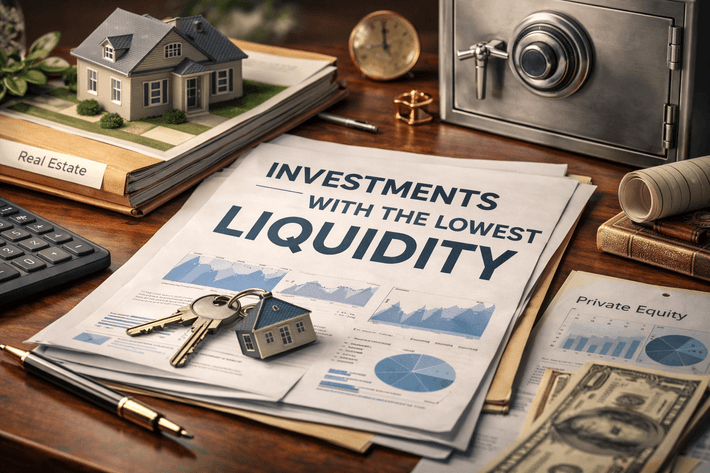
Low Liquidity Assets
With low liquidity assets, you’re investing for the long run, and simply cannot trade them at any time of the day like you would with regular stocks for example.
- Real Estate: It can take months or even years to sell a real estate property.
- Private Equity and VC: With these investments, your capital is commonly locked up for 5-10 years before you can trade it.
- Collectibles: Most of the items that are actually worth a lot of money in this area take time to sell.
- Micro-Cap Crypto: If you’re invested in a small altcoin, the liquidity can be extremely low, so any larger sell order can drastically impact the price of the coin.
Conclusion
As you can see, liquidity is what tells you if a market is efficient and healthy enough for you to trade in with as little friction as possible.
Where others follow the volume, you can follow the liquidity in order to protect your bottom line and to ensure that your trading strategy remains resilient in the long run.

I have always thought of myself as a writer, but I began my career as a data operator with a large fintech firm. This position proved invaluable for learning how banks and other financial institutions operate. Daily correspondence with banking experts gave me insight into the systems and policies that power the economy. When I got the chance to translate my experience into words, I gladly joined the smart, enthusiastic Fortunly team.