
Impulse Buying Statistics

Consumers have always made impulse purchases, as most of us have at least once in our life spent money on things that we didn’t really need.
In recent years, however, this type of consumer behaviour has become a real issue for a large number of people, as the convenience of online shopping and the influence of things like social media, Buy Now, Pay Later apps, personalized ads and many other things are having an ever larger impact on how we spend our hard-earned money.
And the reality is, that more and more of us are spending it rather carelessly and unwisely.
Key Impulse Buying Statistics: Editor’s Choice for 2026
- 62% of consumers regretted an impulse purchase.
- 81% of consumers had made an impulse purchase in 2026.
- 22% of Americans made impulse purchases that significantly affected their finances in the previous 12 months.
- 48% of social media users have impulsively purchased a product they saw on social media.
- More than 70% of shoppers say that they cannot resist making an impulse purchase.
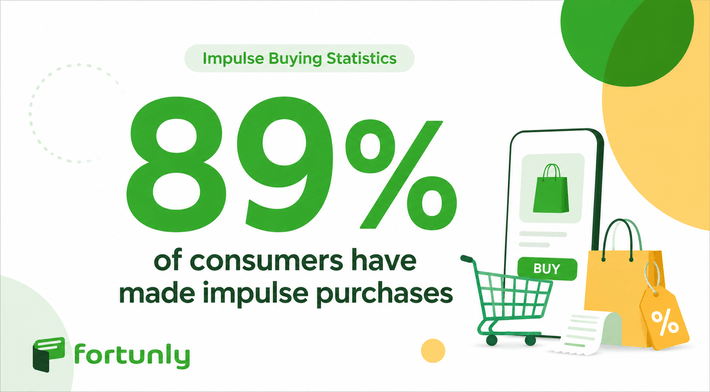
89% of consumers have made impulse purchases.
(Capital One Shopping)
The same research found that impulse purchases now make for around 20% of total eCommerce sales.
The average consumer spends $282 per month on impulse purchases.
(Capital One Shopping)
This amounts to $3,381 on an annual basis, showing how much exactly this behaviour is impacting finances of the majority of households.
81% of consumers have made an impulse purchase in 2026.
(PartnerCentric)
This is in contrast with the same report which showed that 53% of consumers claimed their overall budget is tighter in 2026 than what it was the year before.
62% of consumers regretted an impulse purchase.
(PartnerCentric)
It is no surprise that the majority of impulse purchases end up as regrets, but it is important to highlight that 34% of consumers also experienced financial stress because of impulse buying.
22% of Americans made impulse purchases that significantly affected their finances.
(NerdWallet)
More people than ever are impulsively buying expensive and luxury items, and given the fact that 23% of consumers surveyed in this research made unnecessary purchases due to anxiety and stress shows just how much of a problem this type of behavior can become.
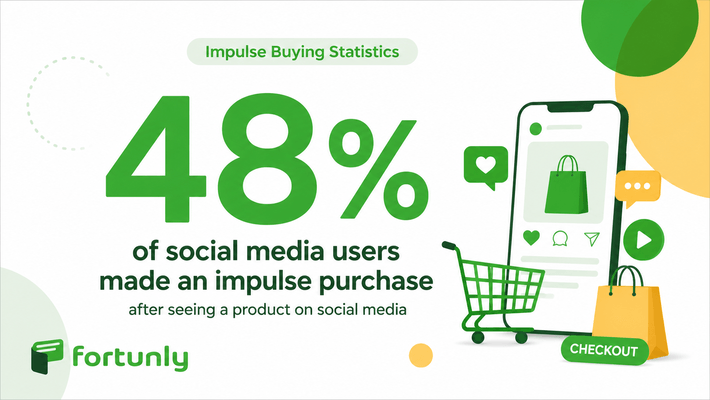
48% of social media users have bought something impulsively after seeing it online.
(Bankrate)
This survey also found that within the past year, some 39% of social media users made such impulse purchases.
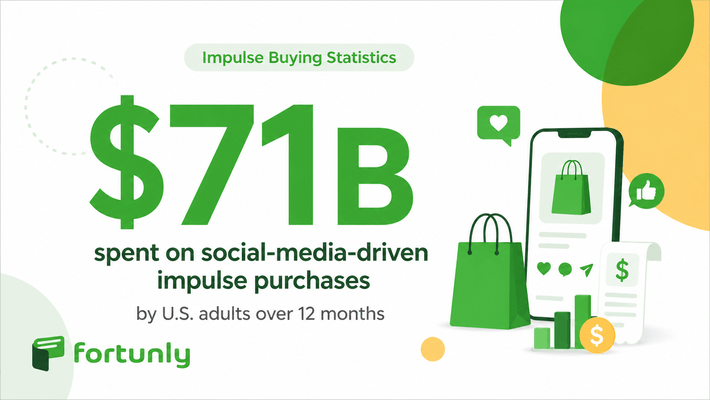
Americans spent $71 billion annually on social-media-driven impulse purchases.
(Bankrate)
The average social media impulse buyer now spends $754 on these purchases each year.
81% of Gen Z consumers make purchases based on influencer recommendations.
(PYMNTS)
The youngest consumers are naturally the most affected by social media influencers when it comes to impulse buying, as only 28% of baby boomers make purchases on influencer recommendations.
Over 80% of Americans reported at least one financial regret from 2025.
(Investopedia)
This survey found that the most common financial regrets of U.S. consumers include overspending on nonessentials, falling into unmanageable debt and having inadequate savings.
Social media, targeted ads, and recommendations increase the risk of impulse purchasing.
(ScienceDirect)
Personalized ads, recommendation engines, retargeting campaigns, and algorithmic feeds make products appear repeatedly and in highly relevant contexts, increasing the impulse buying behaviour among consumers.
Customers who adopt BNPL spend 6.42% more on average.
(Journal of the Academy of Marketing Science)
The increasing popularity of Buy Now, Pay Later services is leading consumers to spend more than they usually would, as delayed payments make nonessential items easier to justify.
Nearly 40% of Black Friday shoppers regretted impulse purchases.
(Tesco Mobile)
The generational divide here is once again shown, as 60% of Gen Z shoppers regretted their purchases, while only 21% of baby boomers did.
Consumers often associate impulse purchases with guilt, shame, regret, and post-purchase dissonance.
(Journal of Retailing and Consumer Services)
The newest study clearly outlines how many negative effects and emotions are triggered through impulse buying.
70% of shoppers say they cannot resist an impulse buy.
(Salsify)
The same survey has also shown that 62% of consumers are driven by flash sales and limited-time discounts in their online purchases.
Nearly one in four consumers makes impulse purchases on TikTok Shop.
(Sprout Social)
The way that the TikTok shop is integrated into the platform makes it a major driver of impulse buying, as consumers can discover a product and check out without leaving the app.
Half of TikTok users spent at least $100 on impulse purchases recommended by shopping influencers.
(Adobe)
The Adobe survey also found that one in four TikTok users who made these purchases spent $150 or more.
31% of Gen X users on TikTok regretted impulse purchases recommended by shopping influencers.
(Adobe)
This was the highest percentage among generations, compared to 25% of both Gen Z and millennial users.
How You Can Reduce Impulse Buying
The simplest and most effective advice we can give is to follow the 24-hour rule, meaning that you always give yourself at least a day before committing to purchase nonessential items.
This alone can massively improve your overall purchasing behaviour, but you can also employ other tactics, such as removing your saved payment information, unsubscribing from newsletters and promotional email offers, or setting strict monthly spending limits.
We’d also advise that you always keep track of all your purchases within a month, as actually seeing an exact number can make it easier for you to decide if you should better manage your finances or use them more wisely the following month.
Final Thoughts
As you can tell from the numbers we outlined above, impulse buying is becoming an ever-larger problem for the majority of consumers today.
By recognizing the dark patterns that companies and services use to attract you, and by employing some of the methods to help you manage your impulses, you can save yourself a lot of stress and trouble in the long run.

I have always thought of myself as a writer, but I began my career as a data operator with a large fintech firm. This position proved invaluable for learning how banks and other financial institutions operate. Daily correspondence with banking experts gave me insight into the systems and policies that power the economy. When I got the chance to translate my experience into words, I gladly joined the smart, enthusiastic Fortunly team.