
Subscription Spending Statistics for 2026

Spending on subscriptions has quickly and somewhat quietly become a major financial burden for a majority of U.S. households.
With more and more companies swarming consumers with increasingly ridiculous subscription-based models for products that they once owned on purchase, many Americans are becoming not only adverse to these models, but are becoming increasingly selective on what they spend money on.
Key Subscription Statistics: Editor’s Choice
- U.S. consumers spend an average of $1,887 annually on subscriptions.
- 44% of U.S. consumers spent more on subscriptions in 2025 than they did the year before.
- The average U.S. consumer has 3.4 active paid subscriptions in 2026.
- Consumers waste an average of $26.79 per month on unused paid subscriptions.
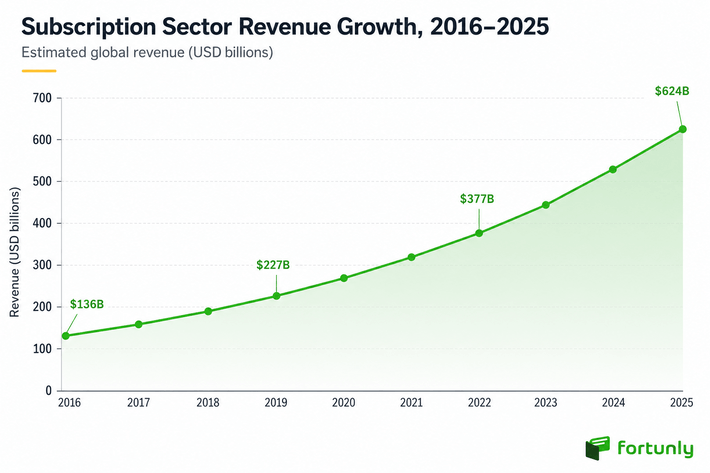
- The global subscription economy is projected to reach nearly $1.2 trillion by 2030.
American consumers spent an average of $1,887 on subscriptions in 2025.
(Mastercard)
The latest report from Mastercard found that the average annual cost of subscriptions per consumer increased from $1,416 just a year before.
44% of U.S. consumers spent more on subscriptions in 2025.
(Mastercard)
Even though there’s been an increasing number of people complaining about subscription fatigue, the actual data has shown that the model is rapidly growing.
Monthly churn for subscription services has risen to 20%.
(FT Strategies)
The other side of the coin here shows that there is an actual oversaturation in the subscription services market, as more consumers than ever before are cancelling subscriptions or stopping using the services entirely once they feel they’re no longer worth the cost.
The average consumer has 3.4 active paid subscriptions in 2026.
(Self Financial)
This is up from 2.8 just a year before, but is still below the 4.4 average, which was recorded in 2023.
59.9% of consumers have at least one unused paid subscription.
(Self Financial)
The same report found that, of those that pay a monthly subscription for a service they do not use, that the average person had 2.6 of those paid services.
U.S. streaming households spend an average of $69 per month.
(Deloitte)
Streaming services are among the most commonly paid subscriptions, and the latest data shows that consumers are not going to pay for all of them separately, but will instead rotate subscriptions or cancel services after watching a show or a movie they were interested in.
68% of streaming subscribers have at least one ad-supported plan in 2026.
(Deloitte)
This number is 20% higher than it was just two years earlier, showing that many consumers are willing to downgrade to a cheaper ad-supported plan rather than straight out cancelling their streaming subscriptions.
66% of streaming cancellations are driven by cost.
(YouGov)
Many subscription services have increased costs over the past few years, especially for non-ad plans, so it is not surprising that this is the main factor driving the streaming churn.
Nearly 23% of U.S. subscribers spend more than $100 per month on subscriptions.
(Bango)
For a quarter of American consumers using subscription services, the monthly costs now equal their utility bills.
Americans spend about $205 per year on unused subscriptions.
(CNET)
With so many subscription services available to customers, there has also been a sharp increase in the amount of money spent on services that users rarely or never use, but simply forget to cancel.
80% of U.S. adults paid for at least one subscription in 2025.
(CNET)
Subscriptions are a mainstream part of consumer finances, as more and more Americans are heaving at least one active subscription at all times.
The global subscription economy is projected to reach nearly $1.2 trillion by 2030.
(Juniper Research)
The latest research indicates that the subscription economy will continue to rapidly grow, increasing by 67% by 2030.
U.S. video game subscription spending grew 20% in 2025.
(Sensor Tower)
Video game subscriptions in the U.S. have increased from $51.7 billion in 2024 to $52.3 billion in 2025.
Paid music subscriptions generated $6.4 billion in U.S. revenue in 2025.
(RIAA)
Last year also saw a 6.8% percent increase in premium paid subscriptions.
Spotify reached 293 million Premium subscribers in Q1 2026.
(Spotify)
The number of Premium subscribers increased by 9% compared to 2025.
Amazon Prime has more than 201 million U.S. subscribers in 2026.
(CIRP)
Amazon Prime has held a steady amount of subscribers after reaching 200 million members in 2025.
Walmart+ reached an estimated 30.7 million members in early 2026.
(Morgan Stanley)
Walmart is increasingly challenging Amazon, as it has record-high numbers of subscribers this year, with users looking for an app that has multiple benefits for delivery, fuel and other retail benefits under one umbrella.
Uber One members accounted for about half of Uber’s app activity by 2026.
(Business Insider)
This number shows how important membership programs can be, with users feeling the need to use the service more often in order to justify their spending.
The New York Times had 12.8 million subscribers in 2025.
(The New York Times Company)
The New York Times added some 1.4 million new digital subscribers last year, showing that news and lifestyle subscriptions continue to grow and are now a crucial part of the overall revenue of these companies.
YouTube Music and Premium reached 125 million subscribers globally.
(YouTube)
The data from 2025 has shown that YouTube continues to grow as users increasingly look for ad-free and offline viewing experiences.
ChatGPT had 50 million paid subscribers in 2025.
(Business of Apps)
This includes paid products such as ChatGPT Plus, Pro, Team, Enterprise, and other business-facing plans.
Claude paid subscriptions more than doubled in early 2026.
(Anthropic)
While Anthropic doesn’t publish actual subscription numbers, the company’s flagship Claude product has exploded in popularity in recent months, offering perhaps the most advanced AI solution on the market right now.
Netflix’s ad tier reaches more than 250 million monthly active viewers in 2026.
(TheWrap)
This was a major increase from 190 million in November 2025. More than 80% of ad-plan members actively watch each week.
Final Thoughts
As you can see, subscriptions are now easily one of the main cornerstones affecting monthly budgets of hundreds of millions of Americans and billions of people worldwide.
While there’s been a growing negative sentiment towards them, especially when people hear about the more ridiculous services like paying a subscription for printer ink, the reality is that this market continues to grow at a rapid rate.

I have always thought of myself as a writer, but I began my career as a data operator with a large fintech firm. This position proved invaluable for learning how banks and other financial institutions operate. Daily correspondence with banking experts gave me insight into the systems and policies that power the economy. When I got the chance to translate my experience into words, I gladly joined the smart, enthusiastic Fortunly team.